Rain crucial for 2026 traditional orchard harvest in Germany: 450,000 tonnes expected
Rain crucial for 2026 traditional orchard harvest in Germany: 450,000 tonnes expected
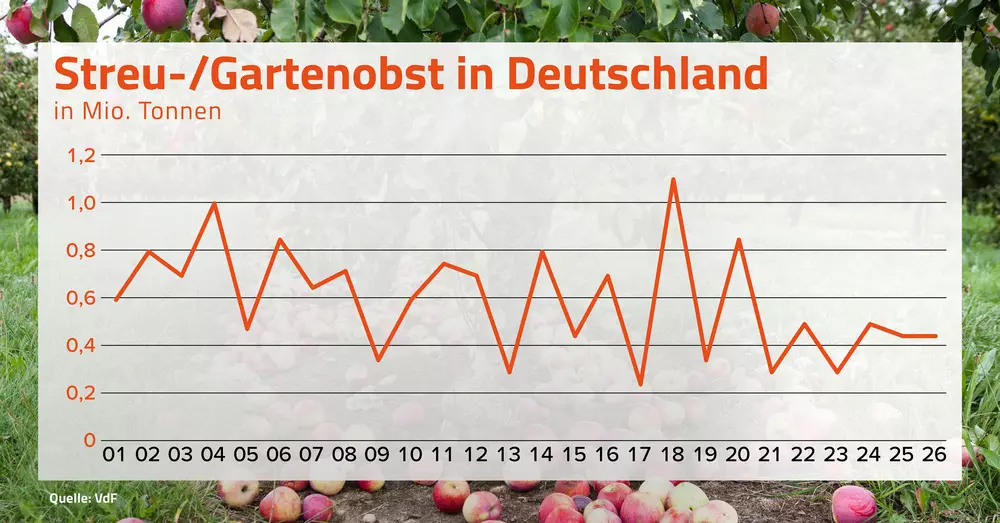
The German Fruit Juice Industry Association (Verband der deutschen Fruchtsaft-Industrie e. V., VdF) expects around 450,000 tonnes of fruit to be harvested from traditional orchards in 2026. Whether this volume will actually be achieved, however, will depend largely on rainfall over the coming weeks.
28-07-2026
The German Fruit Juice Industry Association (Verband der deutschen Fruchtsaft-Industrie e. V., VdF) expects around 450,000 tonnes of fruit to be harvested from traditional orchards (Streuobst) in 2026. Whether this volume will actually be achieved, however, will depend largely on rainfall over the coming weeks.
“There are enough apples on the trees, but the fruit is still very small at present,” explains VdF Managing Director Klaus Heitlinger. “An increase in diameter of just one centimetre can significantly boost the total crop. Rainfall is therefore crucial now. If the rain fails to materialise, the apples will stop growing and may drop prematurely.”
According to the association, the next two weeks will be decisive for the further development of the crop. Experience shows that strong crops can become even heavier as the season progresses, whereas estimates for weaker crops often have to be revised further downwards.
Major regional variations possible
Harvests from traditional orchards are subject to pronounced annual fluctuations, partly due to biennial bearing. This pattern was further exacerbated by the late frost in 2017.
Harvest volumes may also differ considerably between regions. Localised rainfall over the coming weeks could mean that actual yields in individual areas vary substantially from the national forecast.
Yield potential of orchards declining
Irrespective of annual fluctuations, the yield potential of many traditional orchards in Germany has declined in recent years. While a crop of more than one million tonnes was still forecast for 2018, the dry summers from 2019 to 2023 in particular have taken their toll on the trees.
Many trees in traditional orchards suffer from inadequate water supply. The advanced age of many orchards is another factor. A large proportion of the trees are more than 80 years old and are increasingly approaching the end of their natural lifespan.
Traditional orchards are valuable ecosystems
Klaus Heitlinger stresses that the importance of traditional orchards extends beyond their economic role: “Traditional orchards provide a habitat for more than 5,000 species of plants and animals. At the same time, the diversity of fruit species grown creates distinctive flavour profiles that are valued by many consumers. Products such as apple juice from traditional orchards, as well as quince and pear juices, are therefore highly popular.”
In view of the effects of climate change and the ageing of many orchards, German fruit juice producers are working to preserve and promote traditional orchards. Measures include planting initiatives and premium-price schemes that enable higher producer prices to be paid for fruit from traditional orchards.
Crop estimates with a trained eye
For 32 years, the VdF has conducted what it calls a processing apple crop-load assessment. The method was developed at the Lake Constance Fruit Growing Competence Centre (Kompetenzzentrum Obstbau Bodensee).
Using a special telescope known as the “Gucki”, volunteer assessors examine ten sections of each tree and count the apples. A nationwide crop forecast can then be derived using a defined calculation method. (Source: press release issued by the German Fruit Juice Industry Association (VdF))