Conference most susceptible to leaf scorch
Conference most susceptible to leaf scorch
14-8-2026
Of all the cultivars in the trials at pcfruit, Conference and Celina are the most susceptible to leaf scorch, researcher Ann Gomand told visitors during the open day at the Belgian pcfruit research station on 11 August.
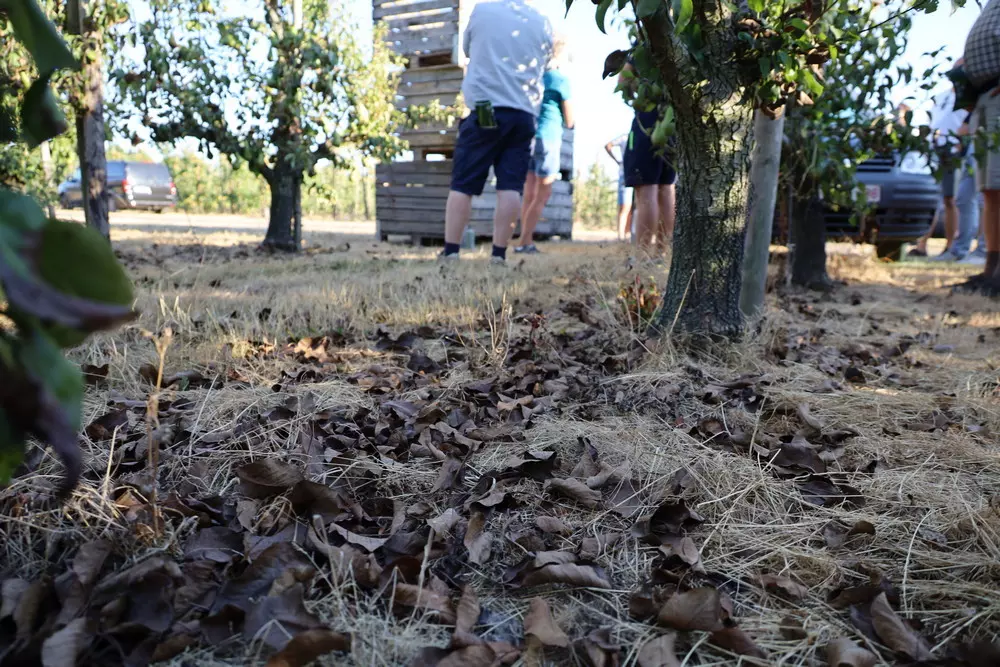
As a result of the dry, hot summer, considerable leaf scorch and leaf drop can be seen in Conference at the research station. Remarkably, there are major differences between training and pruning systems.
This was clearly visible in an older trial comparing different tree forms. Conference trees trained as Tiense Haag or as long-pruned spindle trees suffered more leaf scorch than V-hedges, spindle trees and candelabra-trained trees. A mechanical-pruning trial also showed that mechanically pruning the sides of Tiense Haag and long-pruned spindle trees resulted in less leaf scorch.
Leaf scorch is caused by a combination of high transpiration and insufficient water supply from the roots. As a result, the leaves dry out and fall from the tree. Less leaf area means less assimilation, with consequences for fruit growth and flower-bud formation for the following year. According to Gomand, there is also a risk of unwanted regrowth once rainfall returns.
Experience from France
In southern Europe, leaf scorch in Conference is a familiar phenomenon. Experience in France shows that leaf scorch occurs more frequently on dry, light soils and on soils with shallow rooting, for example due to root-restricting soil layers. Drip irrigation is often insufficient to prevent leaf scorch. Overhead irrigation is more effective because it also cools the trees. Under-tree sprinkling can also help, as it keeps the grass alleys green for longer and creates a more favourable microclimate.
No clear-cut pattern
Unfortunately, neither the observations at pcfruit nor experience in southern Europe provide a clear-cut picture of the conditions under which leaf scorch does or does not occur. Several years ago, for example, pcfruit found - contrary to expectations - more leaf scorch under hail nets than outside the nets. In practice, however, Gomand says there is no clear relationship between hail nets and either more or less leaf scorch. The same applies to the training system. Belgian pear growers attending the open day also reported that they see no consistent relationship between training system and leaf scorch. Air circulation probably plays a role. Stagnant hot air within the canopy may aggravate the damage, whereas greater air movement may reduce leaf scorch.